Letting Go

One of my favorite poems is The Road Not Taken by Robert Frost. I’ve thought of the road so often in my life, not just for myself, but for people I love. It’s especially hard for parents, when they want the best for a child but the child goes the other way no matter what you say. Eventually, you have to let go…in spite of heartache and worry. You have no choice because you aren’t helping. They don’t hear you. So, you pray they will find their way back and reach their own understanding. I have found, in my own life, that the easy road is seldom the right one…and a loving family member is always the one to listen to.
Robert, in Pages in the Wind, convinces his sister to move to Boston for a new life. But when a boy she loves returns, she rejects her brother’s plan to get her away from a horrid situation and chooses to stay with the boy. But not without seconds thoughts…that may prove to be too late:
The jet climbed into the darkness. The promise of a new life away from Father, Lesley College, and studying art was gone. My body sagged, overcome with guilt that I couldn’t make Robert understand that I had to follow the yearning in my heart. I turned, wiped the tears away, and began walking in the direction of my life with Reid.
I had to turn around. A strange breeze lingered, whispering in my ear, warning me to consider my brother’s words. Robert had told me home was very dark and begged me not to go back there. He said I didn’t have enough light to fight Father. He would have explained everything on the plane. Now I might never know. I looked up and stared at the empty space where he had flown away. Something in the dark void warned me I lost much more than a promise of a new life.
 Writing about desire taps into vulnerability. When I penned Pages in the Wind the plot had significant grit and violence; it was essential to the story. I chose not to weigh it down with explanation or wordy passages. My upcoming book, Brooklyn Bitters, deals with love, betrayal, and loyalty. My character, Kate, is a career woman whose life has gotten away from her. She missed out on romantic love. In this scene, she lets go of her walls and we feel her inner dialogue. It wasn’t hard to write, but it felt, at times, familiar.
 Have you gone somewhere and knew you’d been there before? Met someone and felt an instant connection? What about a snapshot in your mind that disappeared?

 Oh, sibling rivalry. I’ve seen it up close. Fortunately, as the only daughter and a middle child…my role was the peacemaker and I didn’t have anyone to compete with (or wasn’t interested). But I did have a front row seat. It was sometimes entertaining, funny, and at times…upsetting. Where does it come from? I’m pretty sure the seeds are planted early. In this scene of my upcoming novel, Brooklyn Bitters, although subtle…you can get a sense how it started:
 We all need a place to feel safe. For most of us, it’s our home. After a lousy day at work or a dismal day at school, home is a beacon. But what if home doesn’t offer safety? In this passage from Pages in the Wind, eight-year old Emily, talks about her safe place – Grandma’s house:
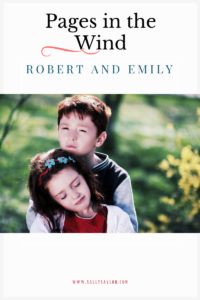 I love the sibling relationship between Emily and Robert in Pages in the Wind. I think it’s especially important in an intense book. We need someone to count on. In this excerpt, the tender relationship is defined:
 She’s not a villain. She’s not even mean. Claire doesn’t neglect her duties. She educates her children and gives them cultural advantages. She decorates her daughter’s bedroom with beautiful French decor. She studies the teen magazines to make sure her child is dressed in the latest trends. But…you won’t love her. You probably won’t even like her. She’s Claire in Pages in the Wind.